

For nearly 20 years, The Legend of Zelda: Ocarina of Time was my favorite game. While it was eventually supplanted by The Legend of Zelda: Breath of the Wild, Ocarina of Time remains a formative, treasured gaming experience that laid the foundation for the wider 3D action genre. However, I am the first to admit that while the original Nintendo 64 version – the only one available on Switch and Switch 2 – has aged better than most games of its era, much like its iconic hero, it doesn’t take long to realize it’s from a bygone era.
For years, I wanted Nintendo to bring the 2011 3D remaster to Switch, but it’s doing me one better: a full, from-the-ground-up remake with lush visuals, several quality-of-life improvements, and even voice-acted cutscenes. We are just weeks away from the launch of The Legend of Zelda: Ocarina of Time on Nintendo Switch 2, and ahead of its November 5 release, I spent over an hour exploring Hyrule as both Young and Adult Link.
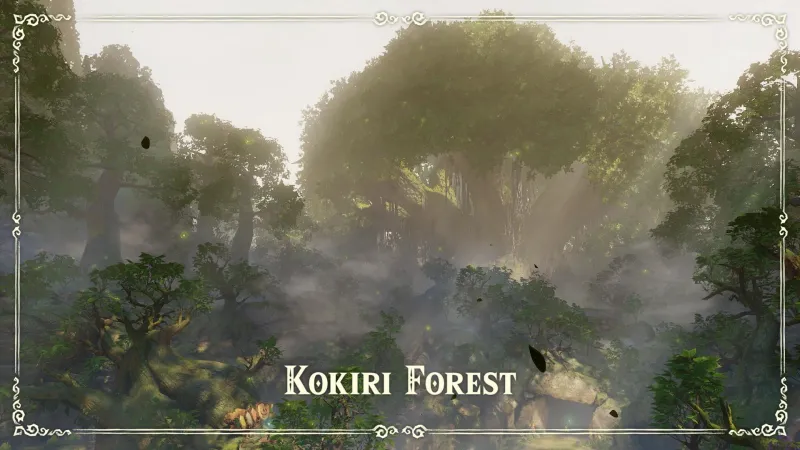
The moment the opening cutscene begins, I feel a smile spread across my face. Seeing Navi and the Great Deku Tree talking about the tree’s impending doom and Link’s destiny through a fully voiced cutscene is a little jarring at first. But the voice acting, along with the incredibly sharp, detailed visuals, definitively hammers home that this is an all-new experience despite being a remake of a 28-year-old game from 5 generations ago. That is further exemplified by Navi’s initial flight, which is no longer in first-person. Instead, we see her say hello to each villager in Kokiri Forest (as she does in the original opening cutscene) before smashing into the fence outside Link’s house and entering to join up with the Hero of Time.
Following a brief conversation with Navi and Saria, who also ran up to Link’s treehouse, it’s time to retrieve the Deku Shield and Kokiri Sword so Mido will let me past to see the Great Deku Tree. As increasingly endearing as Saria is thanks to her improved facial and body animations, as well as her more fleshed-out dialogue, Mido is just as increasingly obnoxious; I was definitely happy to make him eat his words after he mocked Link for previously being the only one without a fairy.

Running around Kokiri Forest is nearly enough to sell me on this remake. The visuals are absolutely stunning. The new jump button and ability to sprint out of a roll make it feel like an all-new game. The freely controlled camera adds to this feeling, even with some relatively basic level design. And while I never had a problem with how Young Link looks in this remake, I’m even more impressed and comforted by seeing him in action in the actual game. In fact, everything surrounding Link also looks great; Kokiri Forest is much more bustling than its previous forms, light fog dissipates as you run through it, and swinging your sword looks better than ever before. Though I love Breath of the Wild and Tears of the Kingdom’s stylish anime-inspired art style, the sheer amount of detail present in each and every character, enemy, and environment accentuates the masterfully executed maximalist approach Nintendo took with this remake.
After finding 40 rupees to buy a Deku Shield, I crawl through the tunnel to the area where you get the Kokiri Sword. This time, however, there’s added verticality as you dodge the rolling boulders to reach a ladder, which you climb and then jump across a gap to reach the chest that contains the blade. This is indicative of small changes dedicated fans will find scattered throughout; I didn’t uncover anything monumentally different from the original game, but eagle-eyed viewers of last month’s Nintendo Direct will notice that Lon Lon Ranch is now on level with the rest of Hyrule Field rather than up on a plateau, and that Kakariko Village is now slightly rearranged. Outside of some small upgrades to the diversity and placement of foliage, I didn’t notice many more differences, but it’s also been several years since I last fired up either the N64 or 3DS version of Ocarina of Time, so it’s entirely likely they were subtle enough that I didn’t notice.

After entering the Great Deku Tree and completing the first part where you jump off the ledge and break through the spiderweb, I must jump to the next part of the demo. Still as Young Link, I watch as Saria gifts Link the Fairy Ocarina through a touching, fully voiced (outside of Link, obviously) cutscene. From there, I’m dumped into Hyrule Field. It doesn’t feel nearly as impressively endless as it felt in 1998, but it is definitely way more beautiful. After a brief conversation with the owl, Kaepora Gaebora, I sprint across Hyrule Field, catching passing yet impressive glimpses of landmarks like Lon Lon Ranch and Death Mountain. One new addition is apparent as I navigate the menus: The Threads of Time. Here, a tapestry tells the story of the Hero of Time in real time; I can look back at what has already happened in Link’s adventure, as well as see how much is still on the horizon. Additionally, if you get lost, the tapestry can give hints for where you’re supposed to go.
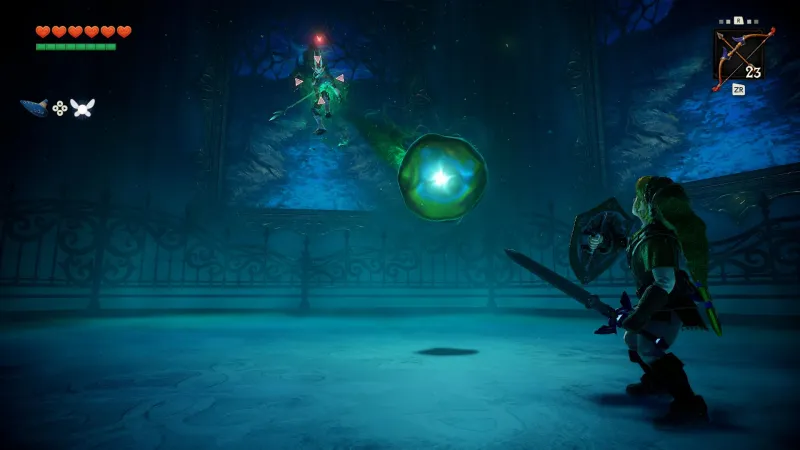
After a brief exploration of Hyrule Castle Town, including a short tour of the Temple of Time, it’s time to jump ahead to the final segment of my demo: the Forest Temple. This section lets me try out Adult Link, who is equipped with the hookshot, and later, the Fairy Bow. This was the one place where my memory felt fuzziest, as I struggled to speedrun the puzzles that I last played through more than a decade ago.

Fighting Wolfos, Stalfos, and Skulltulas is more straightforward than most modern third-person fights, which may be the one area that fell slightly short of my admittedly lofty expectations. Using the lock-on targeting allows Link to dodge and counterattack, but I didn’t find a simple way to swap targets when you’re fighting multiple enemies at once. Instead, I had to release the left trigger, move the camera, and squeeze the trigger again. I get that this is how it worked in the original game, but I would have liked switching to the next target without going through that. Maybe there is an easy way to accomplish that, but I didn’t find it in my nearly 90 minutes fighting through Hyrule.
Regardless of that one reservation, there is no doubt in my mind that The Legend of Zelda: Ocarina of Time will consume my life when it comes out. And with October already halfway in the rearview, we really don’t have long before a whole new generation gets to experience what could very well be Link’s greatest adventure. This remake of The Legend of Zelda: Ocarina of Time comes to Switch 2 on November 5.