
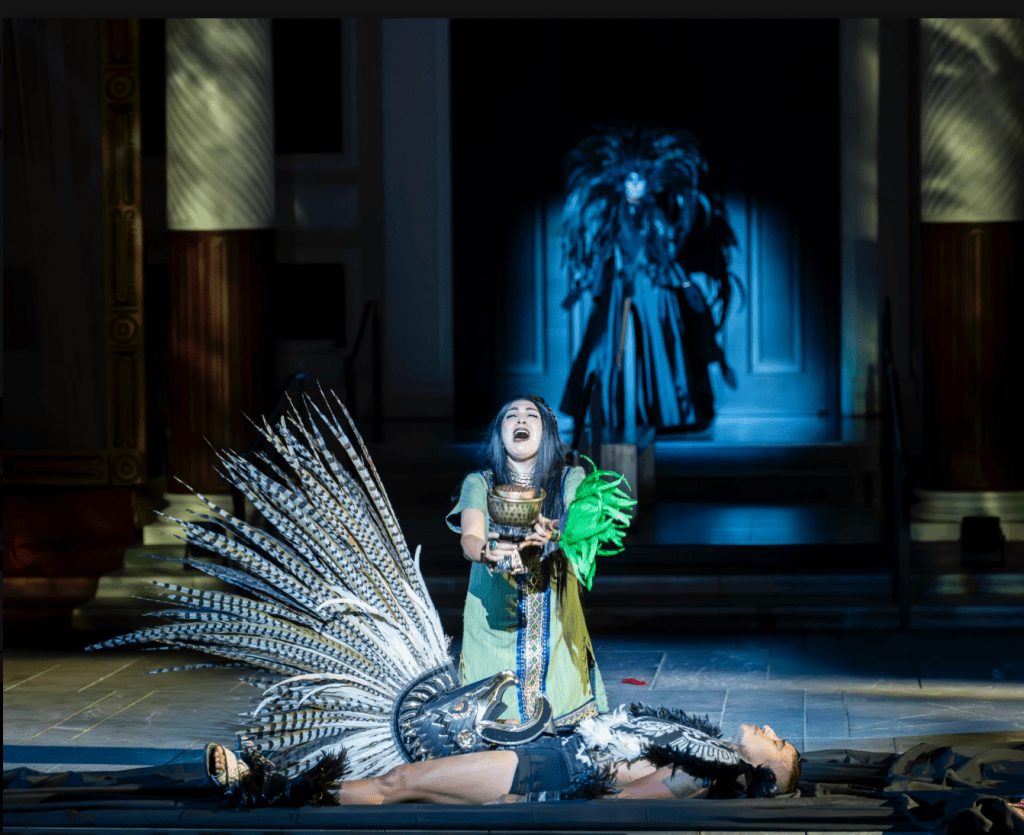
Miquiztli (death and mortality) takes center stage in the Latino Theater Company and Getty Villa’s co-production of ANTIGONE: IN THE LANGUAGE OF KINGS. This gender-neutral, Mesoamerican, Aztec concept-as-figure, casts a decidedly mixed view over the story by its imagery alone.
There was a moment that struck me in Evelina Fernandez’s adaptation of Antigone for the Getty Villa’s Annual Outdoor Performance. A keynote that remains intact from the Greek original, that plays out when the women of the city (chorus) tell Antigone that they are not as strong as men. It is a repetitive (gender) sub-theme in Sophocles’ play, pronounced in this production. One that Antigone wholly rejects. For upon hearing this, she swiftly rebukes them with a bonafide female empowerment list of all the gifts the gods have bestowed upon women. Including, birthing life itself. And, it is an attitude by the tragic heroine that steers, ANTIGONE: IN THE LANGUAGE OF KINGS, firmly on its course.
Because nothing says power better than a dedicated female holding it all together – for everyone.
Antikona (Esperanza América), is not only righteous, but loyal to the core where her family, her forebears and her traditions are concerned. Here she is not a rebellious teen, as is often suggested, but a highly spiritual princess, devoted to the people and the ways of the ancestors. In fact, although the tone of the adaptation is set through Miquiztli (Tiffany Bonita Litz), representing change, the passage of time, transformation and reflection about life’s priorities and past actions, Antikona herself, also, resembles the Goddess Mictecacuhuatl who partly rules over Miquiztli. Antikona in many way personifies the guardian of death, embodying the unyielding, sacred human obligation to respect, protect and care for the remains of the deceased, putting divine/natural law above secular authority.
Antikona’s intensity, stubbornness and rigid devotion to her duty is, also her tragic flaw. And no less than King Creon in his own rigid view of himself and the law that he commands. Here, the two parallel each other quite well. And in keeping with the debate as to whether Antigone or Creon is the focus of the story, Miquiztli steps in, when conflict arises, to draw the audience to the themes rather than the characters. It is well done.
Mixed View
Fernandez’s depiction through her ancestral language and images perfectly aligns with Sophocles’ tragedy, underscoring the clash between Divine and Human Law, Pride and Power. But what seems to be a synthesized Spanish image of Miquiztli kind of stands out as post-conquistador.
In sharp relief to the rest of the production it is dressed in a long, billowing, black, European-styled, textile gown. A “Holy Death” wow factor sweeping across the stage, swallowing up fallen rivals into its voluminous cape. Which, for all of its truly striking appearance, traditional skull and feathered headdress, also slightly (and a bit confusingly) moves away from the intentional indigenous setting just a bit. For it also calls to mind the Goddess who has evolved into popular zeitgeist as the beautiful, skull-dressed image that reigns over the Day of the Dead. And as we are not provided a description of, or background for, this particular figure, it flexes as a decidedly fluid character with interpretation to match.
Astounding Elements
The twenty-four person cast in this production is astounding for the size, and veritably captures all of the tone, topical imagery and feeling of this adaptation. The script itself is beautifully translated. And the Nahuatl language truly a wonder to hear and view on the supertitles above the fray. As well as its authentic music playing throughout each scene. But it stays locked in the parameters of the story. It might have instead, taken a bit more cultural liberty to grab audiences’ imaginations much more, to deliver the significance of its placement into this time period.
Overall, though, ANTIGONE: IN THE LANGUAGE OF KINGS, directed by José Luis Valenzuela is a marvelous refreshing view of an eons old play. And a testament to how story can translate through time, history, language and cultural differences to find similarity, cohesion and meaning.
Recommended.
© 2026 Copyright GiaOnTheMove.com. All Rights Reserved.
ANTIGONE: IN THE LANGUAGE OF KINGS – September 10 – October 3, 2026 Annual outdoor theater production at the Getty Villa
Adapted from Sophocles by Evelina Fernandez. Directed by José Luis Valenzuela. Co-produced by Latino Theater Company with the Getty Villa.
Cast: Castulo Guerra. Esperanza América. Alexis B. Santiago. Zilah Mendoza. Sal Lopez. Geoffrey Rivas. José Eduardo Moreno. Ric Salina. Tiffany Bonita Litz. Alondra Andrade. Stephanie Hoston. Celest Lanuza. Gabrielle Gutiérriz. Richard Azurdia. Randy Vasquez, Israel Lopez Reyes. Sam Golzari. Matias Ponce. Oscar Fabela. Kevin Ortiz. Pollo. Fidel Gomez. Michelle Castillo. Sochi Cuicatl.
Production: Fidel Gomez: Assistant Director. Alexa Wolfe: Stage Manager. Alexa Mora: Assistant Stage Manager. Congziao Fei (May): Production Manager. Francois-Pierre Couture: Scenic Designer. Lee Xinyuan Li: Lighting Designer. John Zalewski: Sound Designer. Christopher Garcia: Mesoamerican Instruments. Catarina Copelli: Costume Designer. Yes Sun Nam: Projection Designer. Urbanie Lucero: Movement/Choreographer. Maesa Pullman: Choral Director. Fermin Herrera: Nahuatl Consultant.
Photo Credit © Craig Schwartz Photography: Esperanza América as Antíkona and Pollo as
Polinices in foreground and Tiffany Bonita Litz as Miquiztli in background.